AI · FINANCE
Plainhub: a financial platform for startups
Plainhub is a financial platform for startups that calculates cash runway, burn rate, MRR and cash-flow forecasts in real time. Its built-in AI financial agent works with company data to help founders understand their financial position and make better-informed decisions.
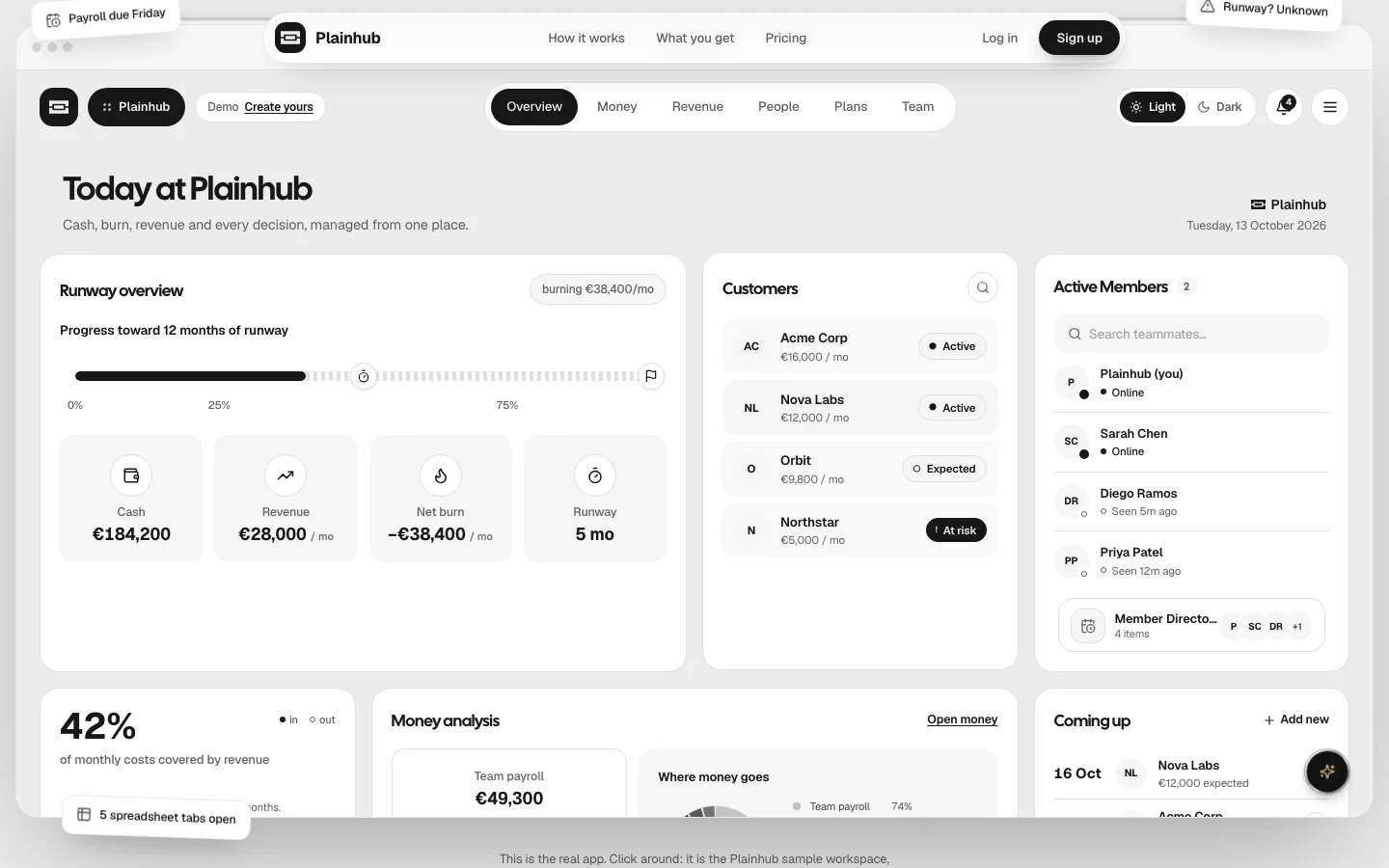
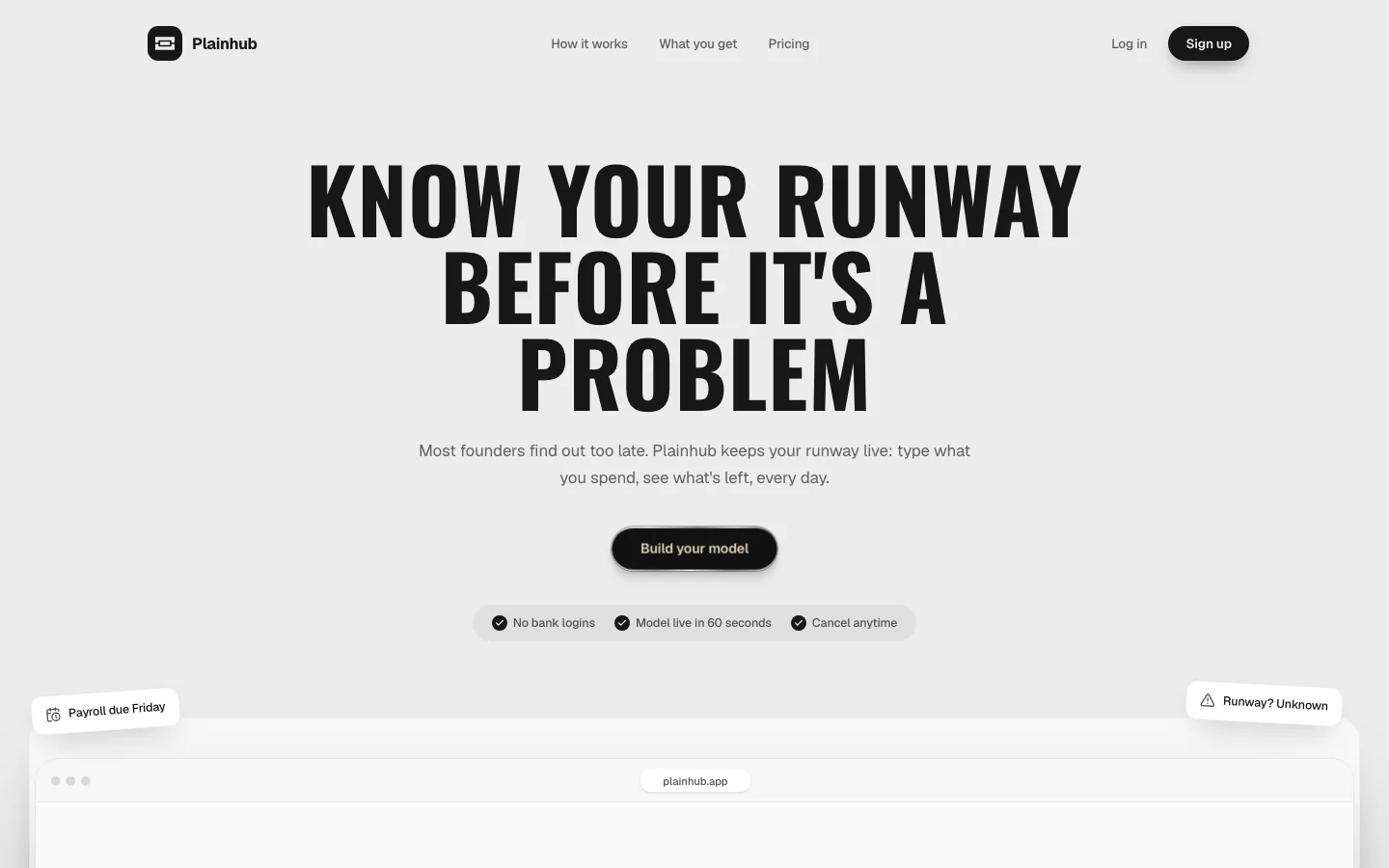
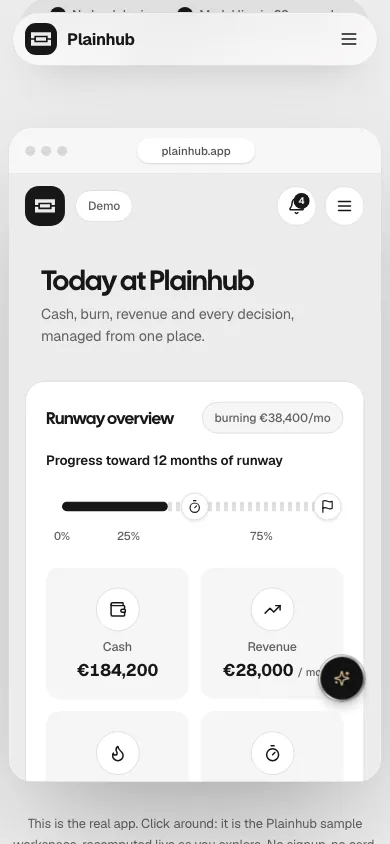

Public pages of Plainhub, captured from the live product
At a glance
- What it is: A financial platform for startups
- Platform: Web app, in any browser
- Language: English
- Built with: Next.js on Cloudflare
- Currencies: 155
- Our scope: Web app, financial model, AI finance agent and public site
What problem does Plainhub solve?
Runway is the number that decides whether a startup survives, yet it usually lives in a spreadsheet that stopped being accurate weeks ago. Accounting tools record the past in detail and say nothing about the future. Bank-connected apps ask for access to the accounts and still leave the founder to work out the one number that matters. Plainhub was built so that founders can see their runway at any moment, instead of rebuilding it the night before a board meeting.
Who is Plainhub for?
Plainhub is for founders of early-stage companies who track money in a spreadsheet and want to know how many months of cash they have left. It also suits the people around them: a team can invite members with roles and per-section permissions, so each person sees only the sections they need. Tasks, comments and a calendar keep the discussion next to the numbers. Plainhub is not accounting software and does not try to replace the accountant.
How was Plainhub built?
We designed, developed and launched Plainhub as a web app. Founders record what happened in plain words, such as a payment, a new customer or a hire, and a live financial model recomputes cash, burn, MRR and runway on the spot. There are no bank logins, statement uploads or accounting integrations: the founder records only the events that move the number. Seven questions set up the first model, and what-if plans show what a decision costs before it is committed to the burn. A built-in AI finance agent works with the company's own numbers.
The project brings together three of our services:
Which decisions shaped Plainhub?
Record events instead of connecting a bank
Connecting a bank account is the usual way to keep a finance tool current, and it is also the step founders hesitate over. Plainhub asks for the events that move the number instead: a payment, a new customer, a hire. Seven questions at setup are enough to build the first model, and after that each event recomputes cash, burn, MRR and runway on the spot. Nothing is uploaded and nothing is linked.
Try a decision before committing to it
In the Plans area a founder enters a hire, a campaign or a cut as a draft first. A draft changes nothing and shows what it would do to runway. Committing it folds its monthly impact into burn from its start date, so a hire planned for next quarter does not shorten today's runway. A tool you cancel goes in as a negative amount and lengthens runway once committed. A scenario view stacks several changes, so two hires and a cut can be judged together.
The agent proposes, the founder confirms
The built-in AI finance agent answers questions from the company's own numbers. When a founder describes something in plain words, the agent shows the figure it understood and waits for a confirmation before the model changes. A misread amount gets caught by eye before it can reach runway.
Put risk next to the numbers
Revenue tracks customers and MRR, and the app warns when a single customer becomes too large a share of it. People shows team cost by department, so a hiring decision starts from what the team already costs. Both come from the same live model as runway.
What is Plainhub built with?
Plainhub is a web app built with Next.js and served through Cloudflare, so it runs in any browser on desktop, tablet or phone with nothing to install. At its core is a live financial model in which cash, burn rate, MRR and runway recompute from every recorded event. The model runs in any of 155 world currencies, each workspace is private to its company, and teams invite members with roles and per-section permissions.
Where and in which languages does Plainhub run?
Plainhub is a web app built with Next.js and served through Cloudflare, so it opens in any browser on desktop, tablet or phone. The model works in 155 currencies, and each workspace is private to its company. The app and its public site are in English. Around the app we built the pages that bring founders to it: calculators, a blog, a glossary and benchmarks. A live demo on a sample company opens without an account, and the financial report can be saved as a PDF from the browser's print dialog. The paid plans are Pro and Max, billed monthly or annually.
What does Plainhub offer today?
Plainhub brings six areas into one model: Overview, Money, Revenue, People, Plans and Team. Together they cover cash flow, customers and MRR, team cost by department, what-if plans and collaboration with tasks, comments and a calendar. The app also warns when one customer becomes too large a share of revenue. A live demo on a sample company opens without an account, and free startup finance calculators, a blog, a glossary and benchmarks are public. There are two plans, Pro and Max, billed monthly or annually.
What does Plainhub not do?
Plainhub is not accounting software. It does not import bank statements, so its numbers are as current as the events a founder records. The AI finance agent works on those same numbers.
What would we keep next time?
We would keep the model small: six areas and seven setup questions, because every extra field is one more thing a founder has to keep current. We would keep the live demo open, since a finance tool asks for trust before it has earned any. We would also keep the confirm step on the agent, because a number on the runway screen should never change on a guess.
Live product: plainhub.app ↗